

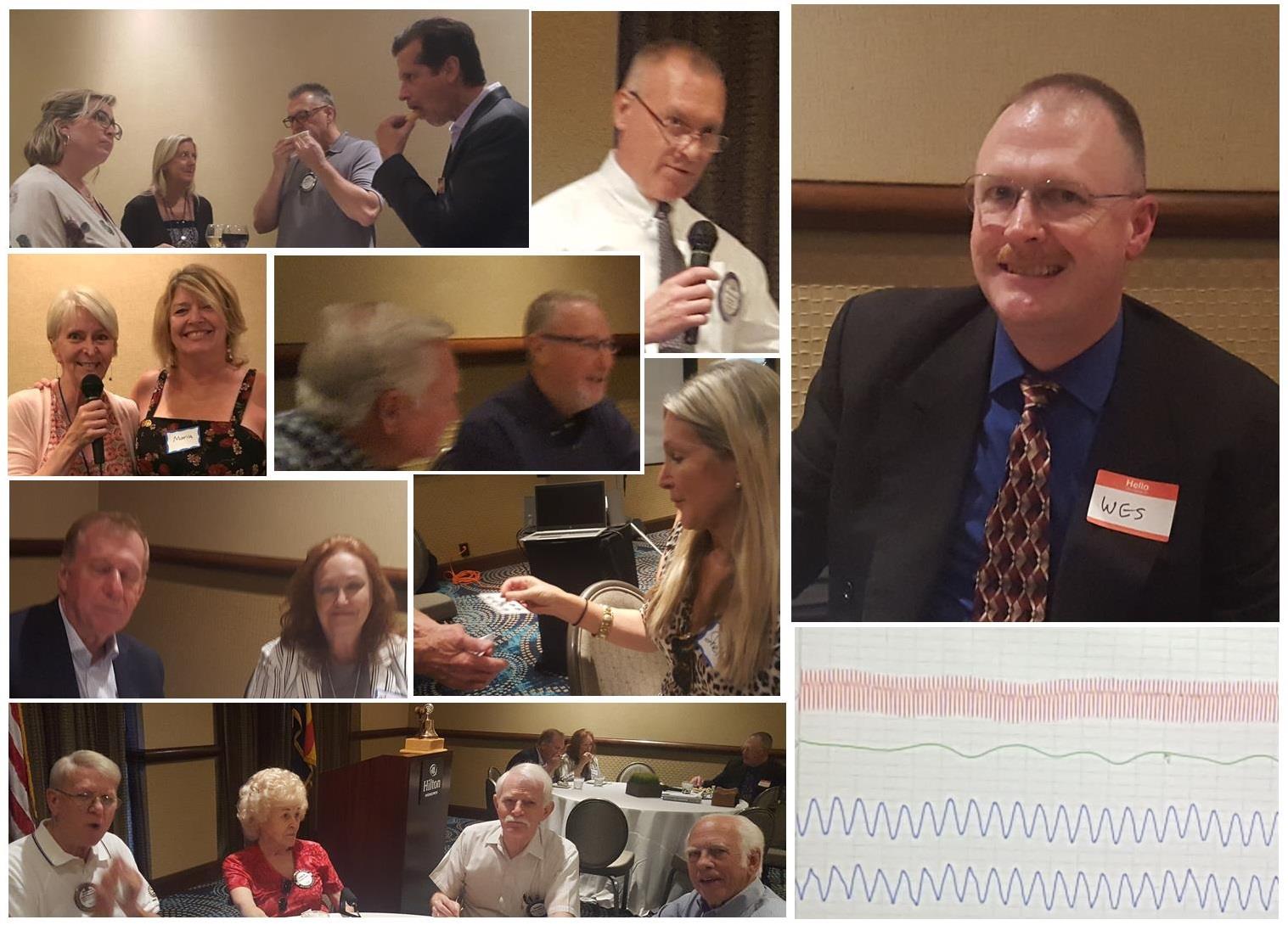
 President Jim Schmidt welcomed everyone to the first regularly scheduled evening meeting of Mesa West Rotary encouraging everyone to enjoy the appetizers and time to socialize before the meeting would be "called to order." Going forward, Mesa West Rotarians who have a difficult time getting away from their busy lives to attend our Thursday lunch meetings, can look forward to gathering and socializing with their Mesa West Rotary friends on the fourth Thursday of each month following their work day.
When the more traditional part of the meeting began, Ray Smith led the Pledge of Allegiance.
President Jim thought he would add more levity to the evening if he bypassed telling another joke about accountants. Instead he said that in discussing possible signature project ideas with Community Service Chair, Melodie Jackson, one of the areas of need is serving forgotten elderly in our community. That reminded him of an elderly lady he had heard about who started rubbing lard on her husband's back. After she started doing that he went downhill quickly.
Guests
Pam Cohen introduced Maria O'Neill, a Rotarian from Sacramento's Point West Rotary Club. Maria is in marketing, including use of social media. She is going to be working in our market for the next several weeks, and when she went looking for a Rotary Club to visit, she found Mesa West through our media presence. Melodie Jackson introduced Shelly, her friend and neighbor, as well as her husband Randy. Don Boucher introduced Wes Burns, who would be speaking later in the meeting, and Don's guests, Marilyn and Steve Helmstadter.
Raffle
For the benefit of our guests, Chuck Flint explained the weekly raffle. Of the money he collects selling tickets, one third becomes the weekly winnings, one third is added to the accumulating pot, and one third goes to the club administrative budget. The person holding the ticket drawn will win $35. If they draw the joker, they will additionally win $20. If they draw the Ace of Clubs (which Mesa West Rotary is) they will win an additional $394. If they draw any other card, that card will be destroyed so the odds get better each week, and the accumulating pot will continue to grow. Melodie's guest Shelly was holding the winning ticket. The card she drew from the deck was the nine of clubs.
Announcements
Pam Cohen reminded everyone of the Feed My Starving Children service project August 29 from 3:30 to 5:30 in the afternoon, stating that to date only 11 had volunteered. She needs Rotarians and their friends and family to let her know if they can plan to be there as she has committed to a team of 20.
Program
Don Boucher introduced our speaker, Wes Burns, a polygrapher whose office is in the same complex as Don's. They connected with each other right away as they both share a background in law enforcement. In getting acquainted with each other, they discovered that at one point they lived five houses away from each other and did not know each other. Wes is a graduate of Brawley High School- the same high school his father and grandfather graduated from. Wes served as President of his school's Interact Club for three years. Wes received a BS in Business Administration from the University of Redlands, and a Master's in Public Administration from Seattle University. In addition to his career in law enforcement, he has served in the US Coast Guard since 1998. He is currently a Lt. Commander. In 2015, he was deployed to Guantanamo, Cuba. Next October, he is due to be promoted to Commander. Since 2007, he has been in private practice as a polygrapher. His company name is Abacus Forensic Polygraph, LLC. Since 2012, he has offered private investigation services under the business name of X Prime, LLC. Wes has been married for twenty-four years. They have a sixteen-year-old daughter and two retired racing greyhounds.
Wes explained that polygraph technology is digital today. The big boxes that used to spew out graphs printed on paper are a thing of the past, but he does have one on display in his office. The kind of questions asked during an exam influences the accuracy. The questions need to be about specific events. When fact based, polygraphs are 90% accurate. Questions should not be about opinion or emotion related to the situation. The reactions the tools measure are involuntary reactions that are impossible to control intellectually. It is basically the fight or flight response that everybody has. The response is much more apparent in children. Life experience can make the response less apparent in adults, but still measurable.
The typical polygraph exam takes about eighteen minutes, but his appointments are typically two hours. There is always a pre-test interview. The examinee typically knows before the test what they will be asked.
The number one user of polygraph exams is the United States government - primarily for security clearances, etc. The most common use of Wes' services is for the clients of the public defender's office.
Socially, when Wes meets new people, he tells them he is a consultant - it keeps the balance of the conversation from being related to his work.
Even though polygraph exams are admissible in court, typically they are used in negotiative discussions between prosecutors and defenders and rarely actually used in court. The courts are his number one stakeholder. He does testing statewide. When he makes up questions, there are zero contractions, zero conjunctions, and have to be very specific.
Senator Ted Kennedy pushed for the Employee Polygraph Protection Act of 1988. That federal law makes it very difficult to test employees because of the rights the legislation created for employees.
In answer to a question about wishing politicians could be polygraphed, Wes responded that his machine would likely burst into flames if a politician was near it.
The test results will be right 90% of the time. An advantage for Wes, because the majority of his work comes from defenders, is that through his law-enforcement background, he is also a skilled interrogator. His services are rarely used to convict. Since his work is done for the defender, it falls under the attorney-client privilege and untruthful findings do not have to be revealed.
One of his most interesting cases was the Washington Linwood Creeper Case. Women of all ages had been groped by a young man when they answered their door. Using their descriptions, an artist's rendering of the perpetrator looked exactly like a kid that was arrested and actually pleaded guilty. However, while the young man was in custody, the attacks continued. The polygraphic exam supported the facts that enabled his exoneration from the false conviction.
Wes is state licensed and monitored. There are no federal guidelines or controls for polygraphers. Rules differ greatly state by state. Arizona has no licensing law for polygraphers. Consequently, there are some phonies. It is an advantage for him that he also has a Private Investigator license.